_1.jpg?ph=9b56dfe271)
S79/OK6RA story
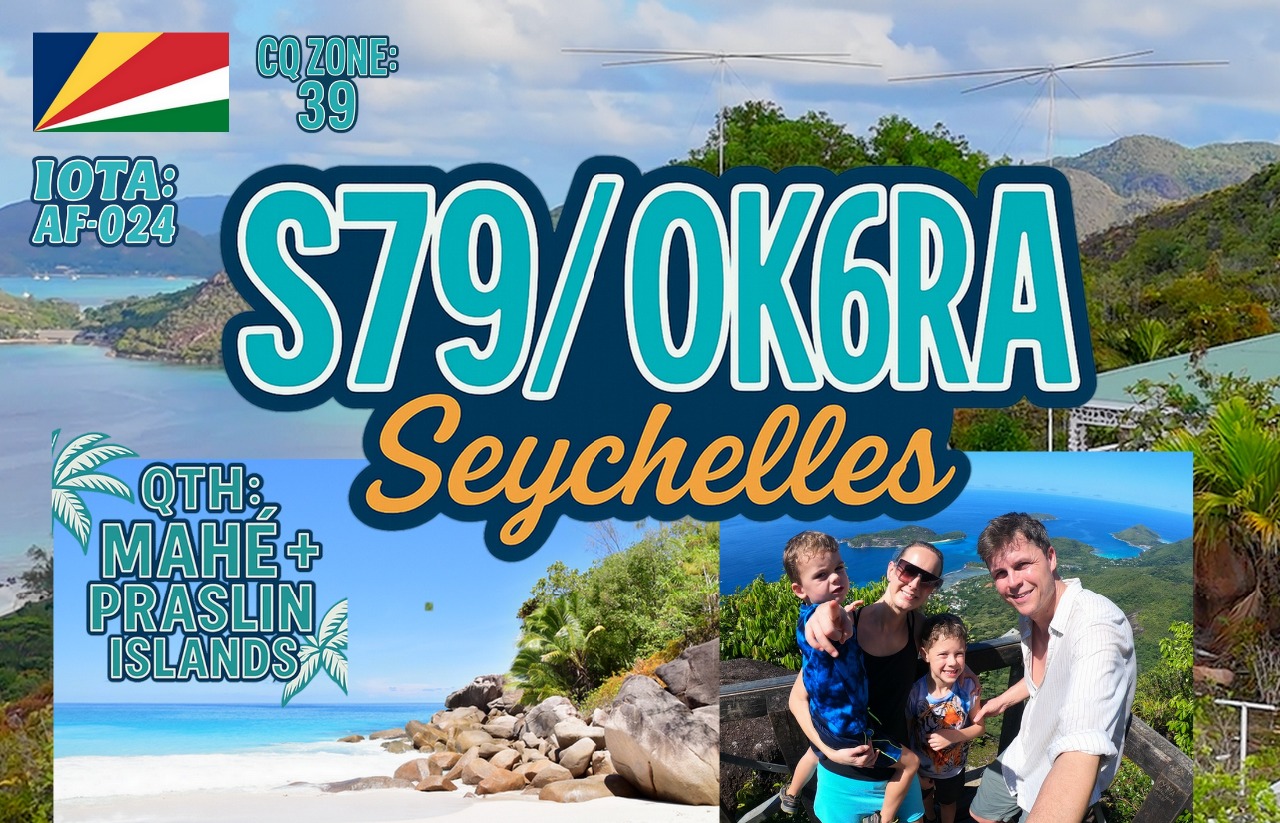 It seems to have become a family tradition for us to head somewhere warmer for CQ WW DX CW. Before that, I had operated with Milan OK1VWK in 2017 as CT9 and in 2018 and 2019 as IH9. The expeditions to Pantelleria inspired by Martin OK1FUA – driving across half of Europe by car and taking ferries – were really fantastic. But that’s a story for another time.
When there were suddenly four of us in the family, I stopped liking the idea of going alone to this contest and leaving my wife at home with the kids. Not to mention that when I was little, my parents never took me further than the edge of the Brdy military area (even though it’s really nice there). So I decided we’d save some money and take the boys somewhere far. When the boys were two and four in 2023, we went on a beautiful combined holiday to Guadeloupe (FG) (shared photo gallery here: https://photos.app.goo.gl/axDNuahJRTvjCg5f7), and a year later to Tenerife (EA8) (photos here: https://photos.app.goo.gl/VWFdkbx265shYfrr9). Countless injuries to the kids, including dengue fever in the youngest one, still didn’t discourage us from another family “expedition”. This time to the Seychelles under the callsign S79/OK6RA. Photo gallery here: https://photos.app.goo.gl/TVvt2zgG4w8AAmLB8.
The Seychelles are a tropical archipelago of 115 islands in the Indian Ocean, east of Africa, known for their beautiful beaches, granite boulders and unique biodiversity, with the capital Victoria on Mahé. All of this topped off with year-round sea temperatures around 27 °C and night air temperatures around 26 °C, going up to about 32 °C during the day. Hard to say no to that.
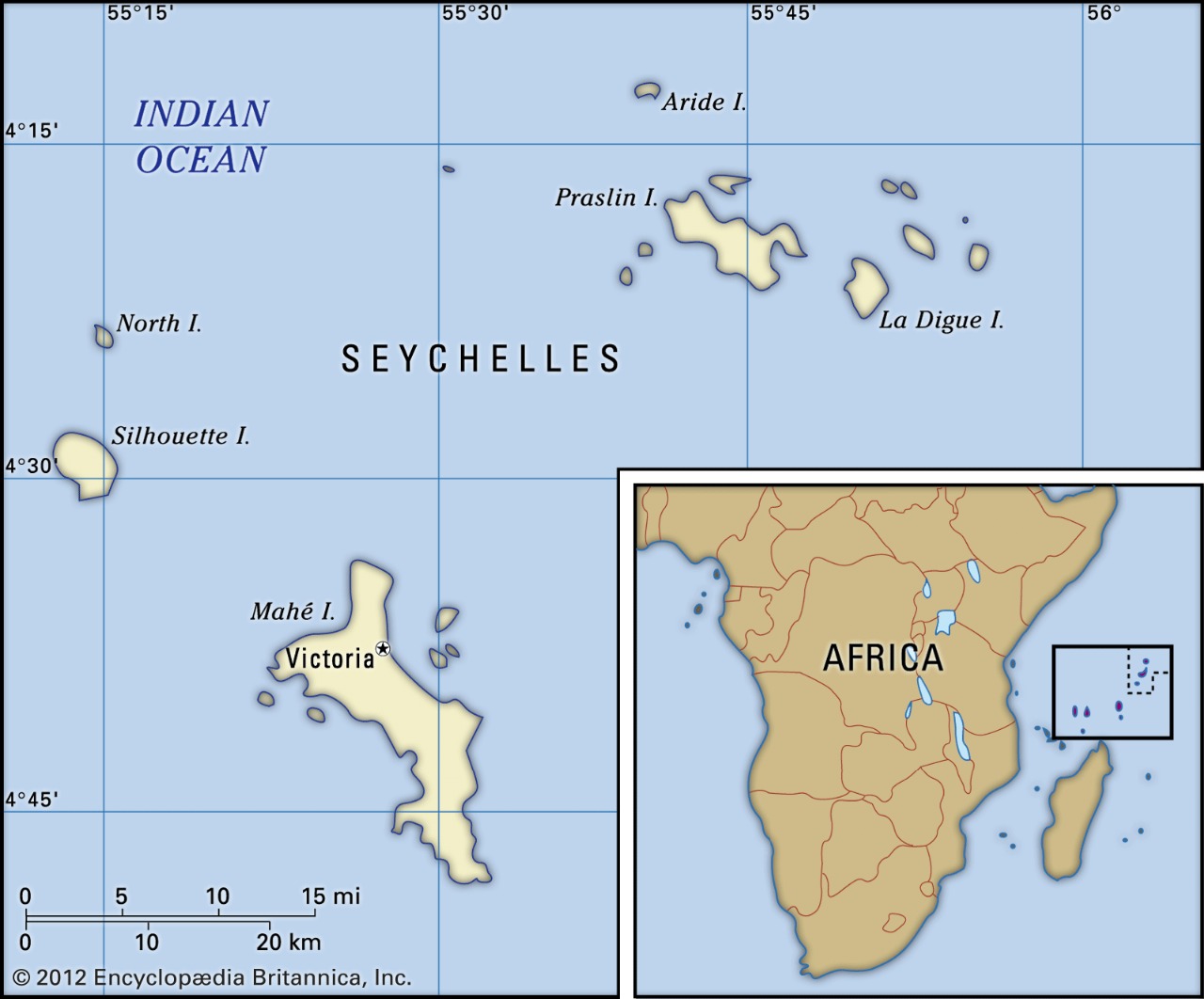
A lot of people imagine these islands as God-forsaken beaches with hardly any people or infrastructure. Quite often the opposite is true, and the Seychelles are no exception. There’s a sizeable population (133,000 inhabitants – that’s about the size of Plzeň), composed mostly of mixed-race Creoles, descendants of the French and Africans, making up about 90% of the population, with minorities of Indians, Malagasy and Chinese. The population density is roughly twice that of the Czech Republic. But we’re talking about averages – most of the 115 islands are uninhabited, form various protected areas and national parks, and it’s actually quite hard for an ordinary visitor to get into truly pristine nature.
The planning of a really “contest-style” holiday basically starts right after the previous year’s contest. In EA8 on Tenerife at the end of November 2024 the weather was nice, daytime air temperatures around 24 °C, but the Atlantic was only about 20–21 °C, and that gives the kids blue lips after five minutes. So last year we told ourselves we needed something a bit milder. But we’re not the type to lie on a beach for days doing nothing. Quite the opposite – my wife has a rather adventurous spirit and she’s not lazy, which I’m really grateful for. She’s a huge support, and most importantly, she understands that radio is what I live for. She has never held me back when I said I was going to a contest or when I just switched the radio on during the week.
Since we’re now at solar maximum, I decided a year ago to try the 10 m single-band category from S79. It’s quite a distance to Europe, and to the USA it’s literally across half the planet, but if not now, when. My favourite beam is the MOXON, which has practically the same parameters as a 3-element yagi, but behaves better at low heights above ground. From IH9 a record on 40 m was set with this type of antenna, from FG a record on 15 m, and from EA8 a record on 20 m. So it’s a proven design. But on 10 m you really want a bit more gain, so sometime in March I started working on a 4× MOXON H-configuration stack for portable use. That means two 12 m masts and two MOXONs on each. I tested the first pair on 10 m in WPX and it performed better than the GXP 13-element (5 elements on 10 m). So far so good.
But as it often goes, solar activity started decreasing in spring, and my excitement about possibly setting another 10 m record faded. It gradually turned into “just” going there to operate and have fun :-). So I packed the well-proven 2× MOXON on 15 m into the suitcase, but also the 4× MOXON on 10 m, just in case conditions picked up again and some new sunspots appeared.
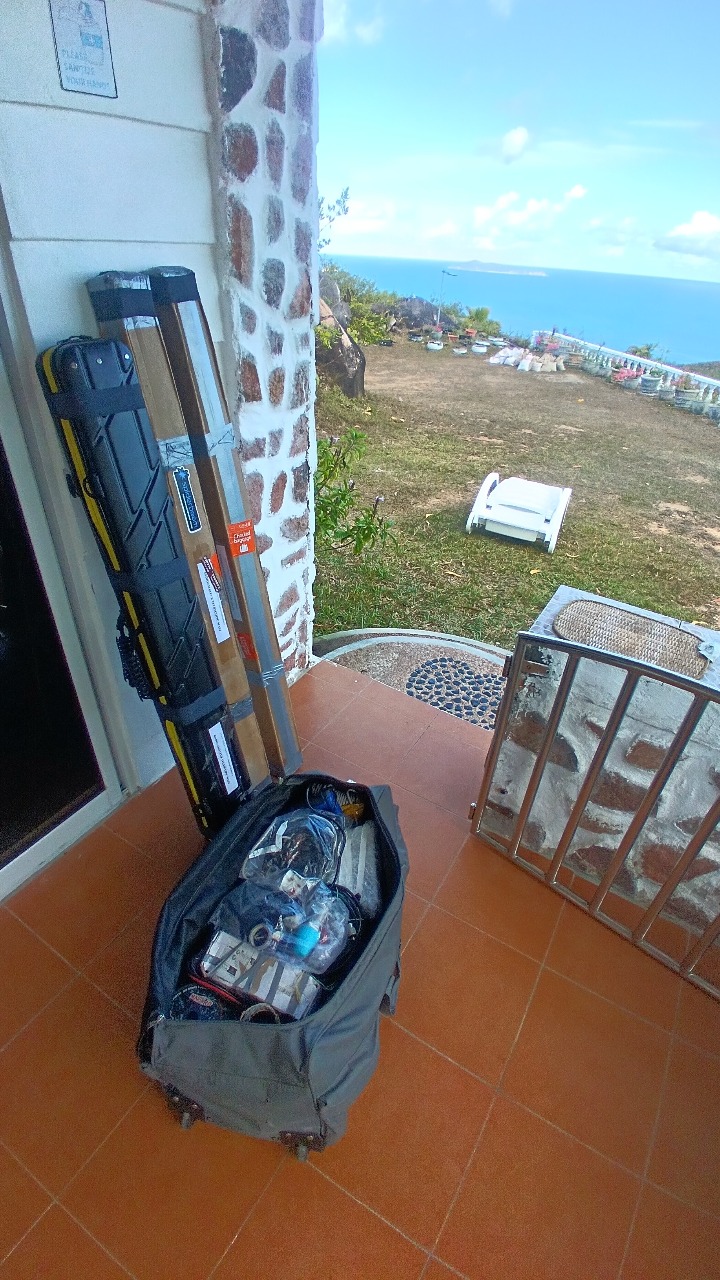
This time I used two identical 10 m aluminium telescopic Spiderbeam masts, which I extended by another 2 m because the antennas I mount on them are super-light and have very low wind load. If you’re wondering why I didn’t use a longer 14 m version of the mast, the answer is very simple: the 10 m version is much easier to transport. In the collapsed state it’s 135 cm long, and in the original cardboard box it comes in, it fits into the standard 158 cm checked baggage size allowed by most airlines (sum of all three dimensions).
The antennas are also designed purely for a one-weekend activity and optimised for transport with minimum weight. The X-frame for each MOXON consists of 4×3 sections of fibreglass fishing rods from Decathlon (these rods contain no carbon, which is quite hard to find these days as fishermen are moving to carbon). The driven element and reflector are made from pairs of twisted insulated copper wires cut from a CAT5 UTP cable. Out of one 10 m patch cord you can make two MOXONs for 15 m. I use these conductors because they’re very light, have thin insulation and still survive winds around 100 km/h. The MOXONs are fed directly with H155 coax, without any balun. There isn’t much of that coax, just a few metres to get to the power splitter. From there I switch to a thicker coax, because 100 W is not much and I don’t want to waste it, so I use a thicker “travel” coax from Messi & Paoloni, specifically AIRBORNE 10, which is about 45% lighter than 10.3 mm cables (e.g. RG-213).
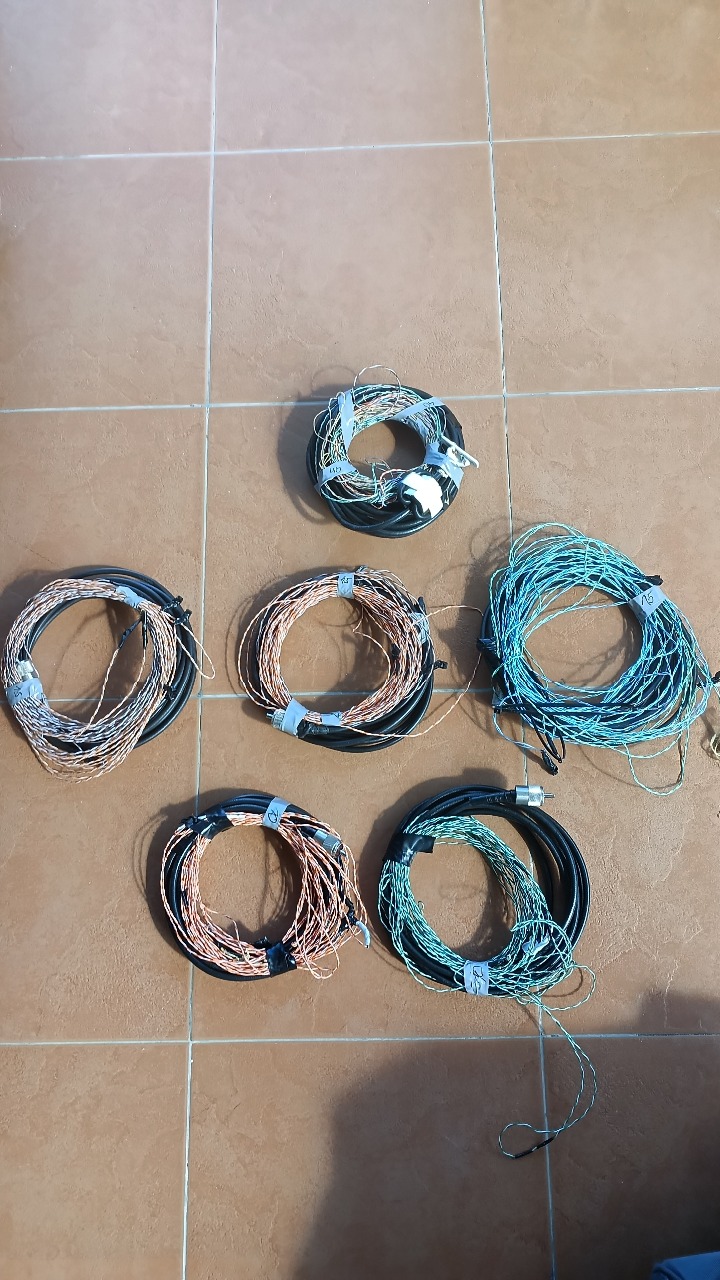
The antenna is attached to the mast by taking two aluminium tubes, drilling two holes for U-bolts in each, and inserting a fibreglass tube from each side. And you do this twice for the X.
The choice of guying rope was obvious: Mastrant. It never lets you down and works great.
Then there’s a small home-made mini-stackmatch with a toroidal core, which I tuned for the top three bands.
I packed a total of eight fibreglass rods and another two telescopes for verticals into a fishing-tackle bag that also fits the standard 23 kg / 158 cm checked baggage limit.
Other essentials we always take include fins and snorkelling gear, a camera, GoPro, and a few toys to keep the kids busy. Plus some schoolwork for older Kryštof. 98% of what’s in our luggage is absolutely useless for survival :-). So in the end I had 4×23 kg checked bags with radio equipment, plus three pairs of underwear, one shirt, one T-shirt, one swimsuit, shorts and sandals + flip-flops.
My wife and the kids managed with two suitcases, most of which was taken up by snorkelling gear.
We bought the flights six months in advance. They definitely weren’t cheap, and there’s hardly anything cheap to the Seychelles, especially when you need checked baggage. We bought tickets with QATAR Airways. They give each economy passenger two 23 kg checked bags. The service is excellent. Free Starlink internet on board, free meals and drinks including alcohol, lots of leg room.
The flight from Prague to Doha in Qatar took about 5 hours, then a 3-hour layover, and a 4-hour leg to the Seychelles. You leave Prague in the afternoon and the next morning you’re in another world. Fortunately, the kids slept through about half of both flights.
On both main islands you can easily pre-book a rental car, which they’ll deliver wherever you want. You need an international driving licence, which you can get at the municipal office in the Czech Republic. Child seats and boosters are recommended but not compulsory. That makes sense since you rarely drive faster than 40 km/h anyway. Still, we bring our inflatable boosters. The cars are in surprisingly good condition for local standards – modern, usually with automatic transmission. I strongly recommend automatic, because like in Mauritius, they drive on the left here. I already have some experience driving on the “wrong” side, so I wasn’t too scared. The worst thing is getting used to the fact that where the indicator stalk is at home, you’ve got the wipers here. So at the beginning of the drive you end up wiping your dry, dusty windscreen instead of signalling :-)
We just about squeezed into a Suzuki Grand Vitara 4×4. Even though it’s a bigger car, I always struggle to fit all my gear in. When choosing a rental car, I always look for something with higher ground clearance, automatic gearbox and preferably 4×4. It’s much better than not being able to get somewhere because the car bottoms out or because the road is too rough.
One more thing about driving and travelling around the islands: driving on the left is one thing, but the roads themselves are another. They’re nicely paved, but the bends are so tight and narrow that you sometimes can’t get round them without stopping and reversing. If you meet a car in one of those bends, the real fun starts. They do have mirrors placed there so you can see what’s coming, but they’re often in poor condition, and sometimes you scare yourself because when you’re turning back through 180°, it’s hard to tell from a distance whether it’s you or someone coming the other way. Particularly interesting are mirrors on hilltops that let you see “under” the crest. So basic rule when planning routes by car here: if the navigation says the drive will take 1 hour, it’ll definitely take 2. And you can’t speed it up. The local blue buses (public transport with no timetables) will happily make you reverse a hundred metres on a narrow section so they can get through the bend.
We had two accommodations booked via Booking. The first week on Mahé, where the international airport is, and the second week for the contest on the island of Praslin. The transfer between the islands was pre-booked on a catamaran ferry that shuttles between the two main islands.
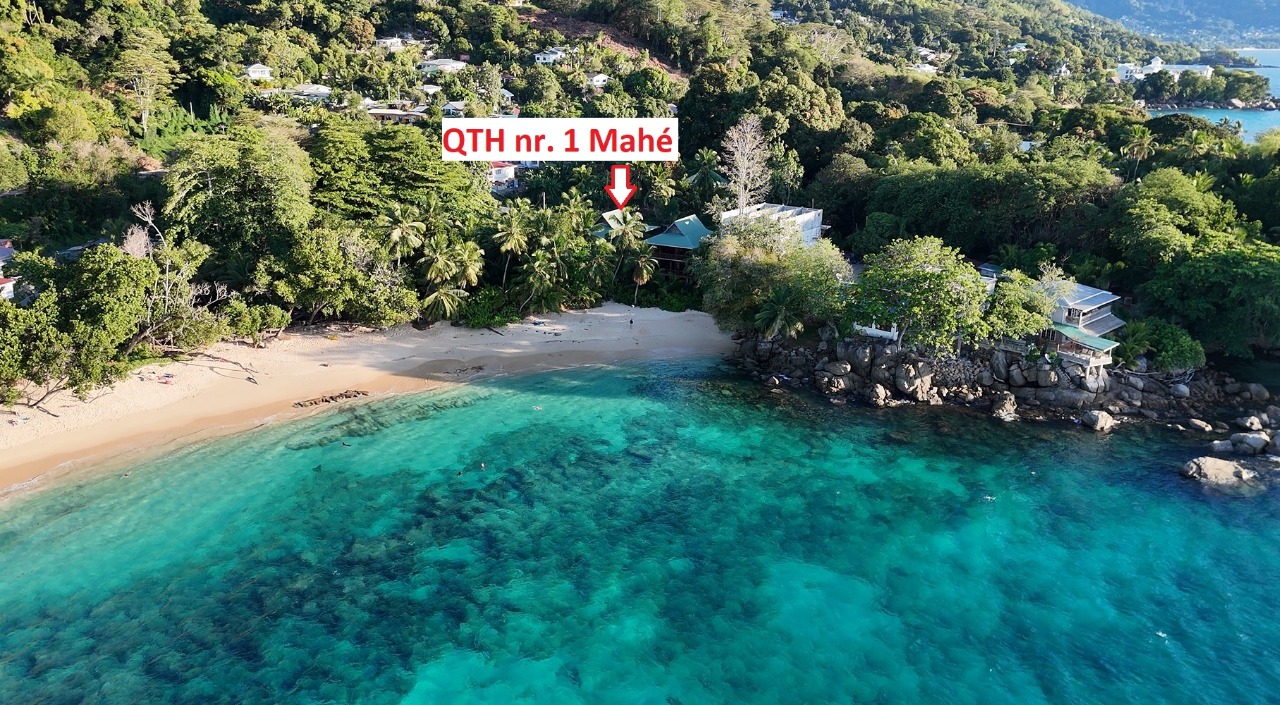
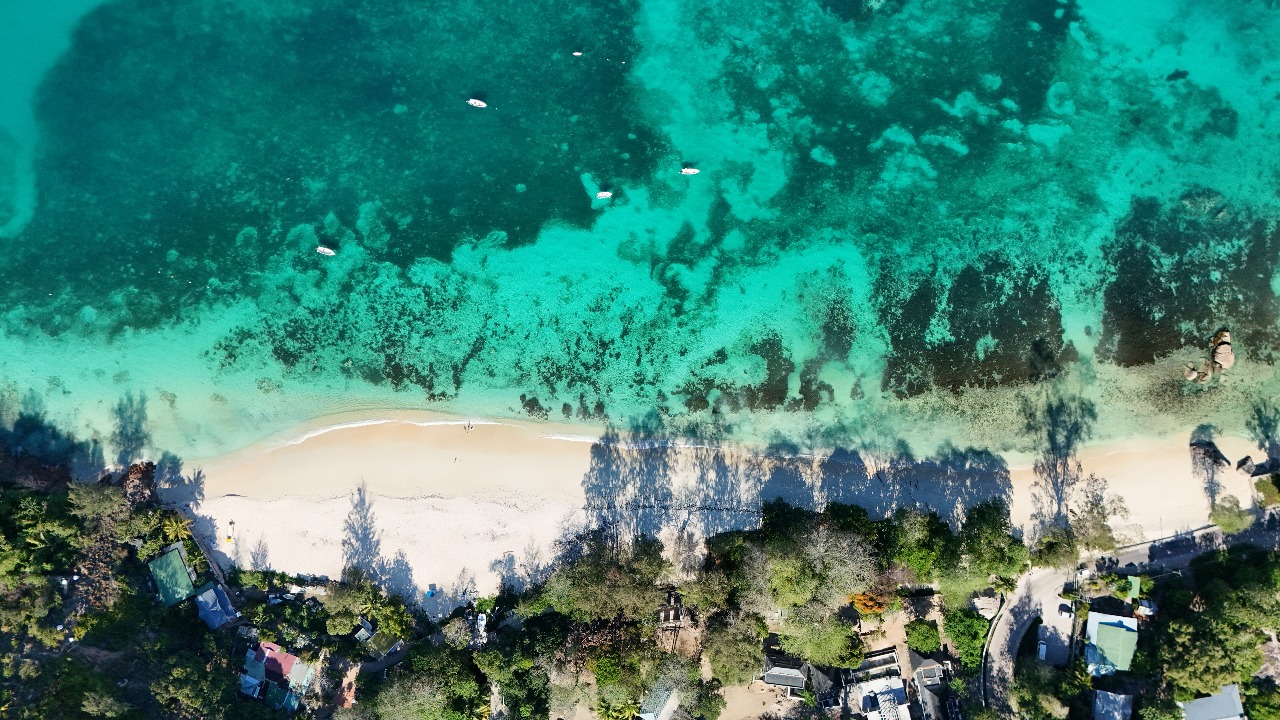
After arriving at the first accommodation, which I didn’t choose with radio operation in mind, we rushed to the beautiful beach right in front of the house, which we had almost to ourselves. A magical place, with a surprisingly clear takeoff towards Europe :-). Even though there were palm trees and dense vegetation all around. After a trip to a small supermarket in the capital to get some food, we unpacked, had dinner and put the kids to bed. Then I unpacked my telescopic mast with a vertical and a single radial (a vertical dipole) and strapped it nicely to the terrace railing with ratchet straps. The SunSDR 2 DX is a great radio for travelling. It doesn’t have a display and always needs a laptop, but it suits me fine: it has two receivers, 100 W output and a reasonably robust SDR front end. I run it with N1MM.
This time I decided not to switch on FT8 at all. My apologies to everyone who prefers this mode and wanted a QSO, but I just didn’t have the energy for it. I wanted to focus on doing simple daily CW sessions before the contest, maybe 2 hours a day, because the few local island HAMs operate mainly SSB and FT8. The 20 m band after sunset and at night played very well. Practically a constant stream of stations, so I had to run split most of the time. Occasionally I ended up on SSB, where it was tougher, but still good fun. According to VOACAP predictions I had made, conditions to JA were supposed to be good. That didn’t really materialise, so the majority of QSOs were into Europe.
The family rhythm on holiday is kind of set. The kids woke up around 6 a.m. with dawn, breakfast, then smearing all those white Central European bodies with SPF 50 sun cream. If we were going somewhere by car, we couldn’t forget to give the kids motion-sickness pills, because those bends really were something. Then we’d enjoy the day and the planned activity, buy more food, beer, wine, rum and water on the way back, shower, dinner, prep food for the next day, put the kids to bed, enjoy some time together with my wife (who always managed to think up what we could do the following day), get on the air, and finally sleep.
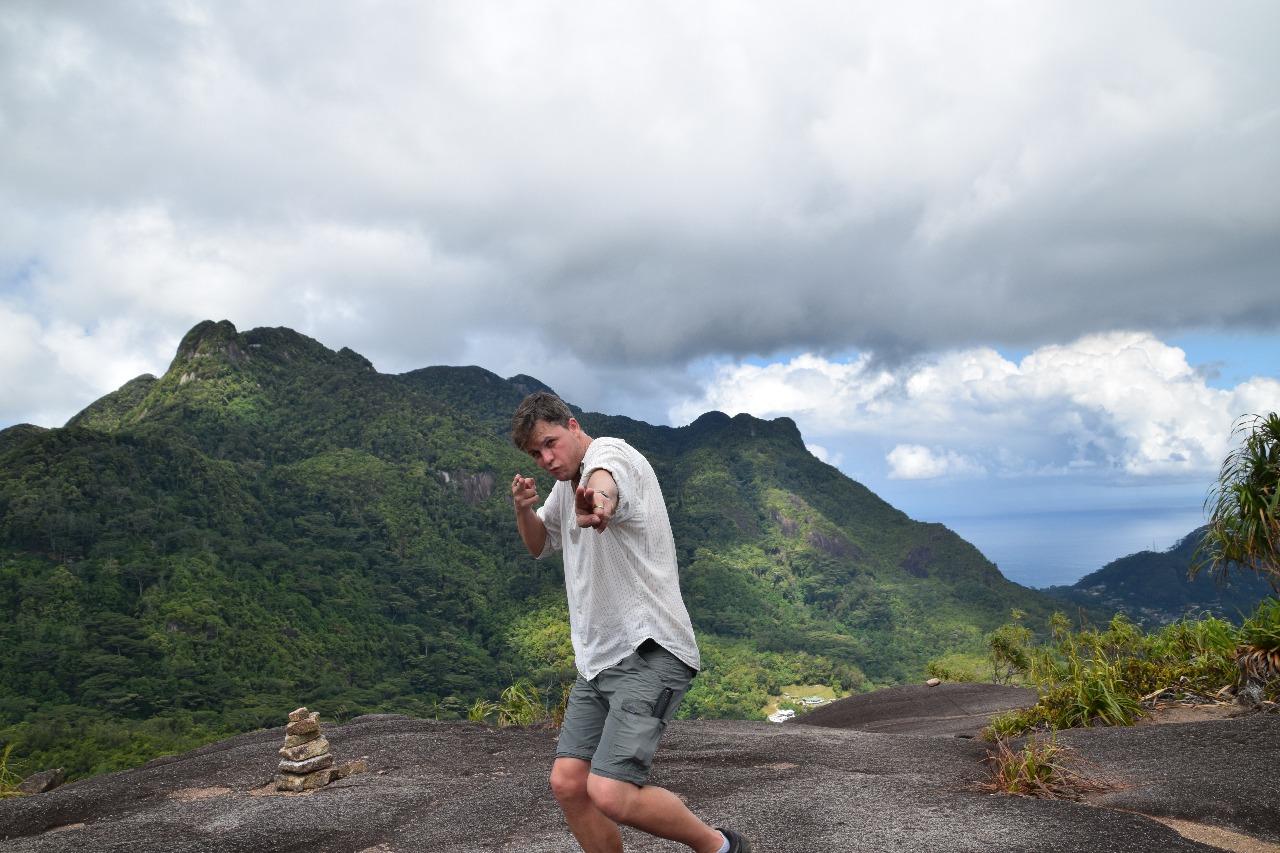
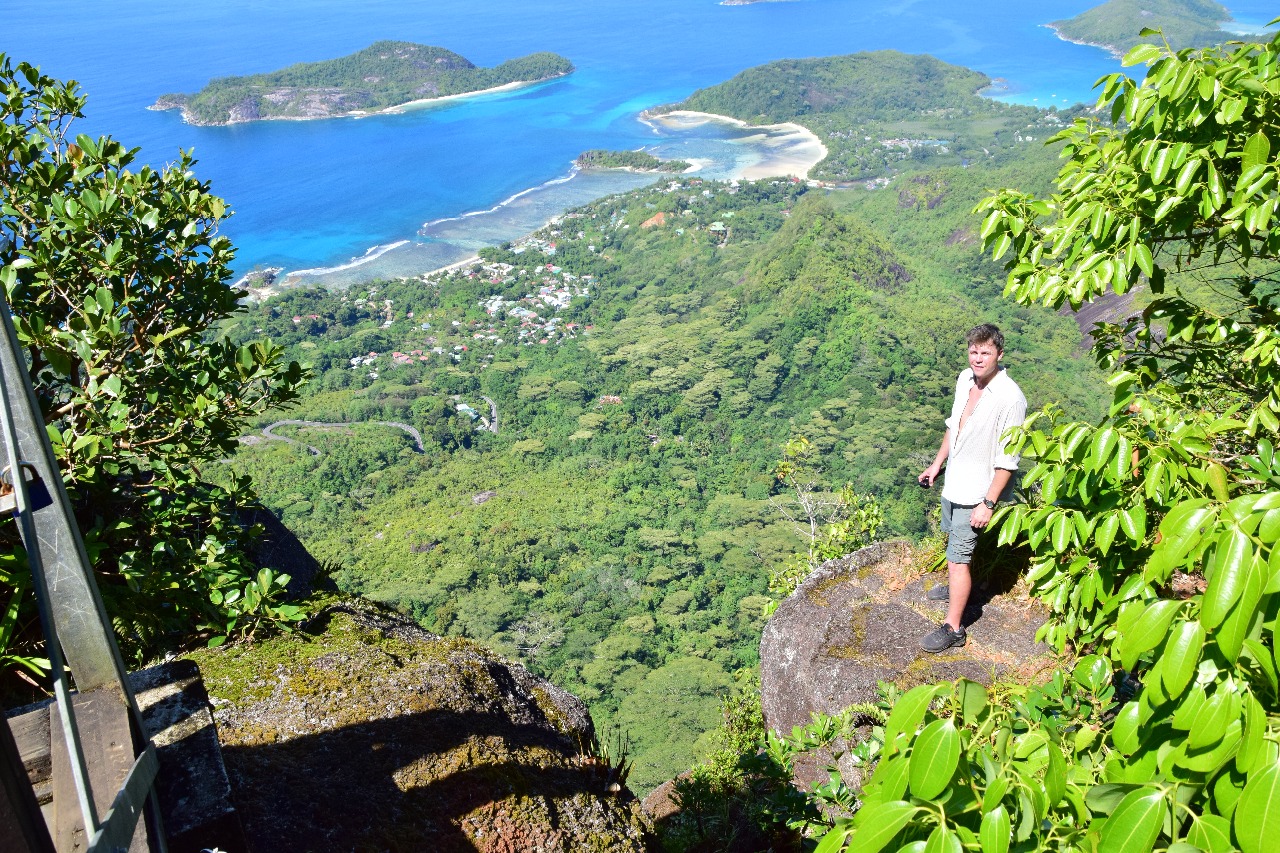
As the days went by, we did several beach trips around the island and also some hikes. The boys are quite used to walking in the hills, but the local humidity in the rainforest and the temperature were pretty exhausting. However, the views from the highest peaks (600–900 m) are absolutely worth the 2–6-hour hikes through the beautiful tropical jungle, where you meet huge but harmless orb-weaver spiders (the largest in the world), black parrots, tropical birds, strange lizards, geckos, snakes, etc. We didn’t make it to the highest peak, Morne Seychellois – maybe if we’d had more time, and you also need a guide.
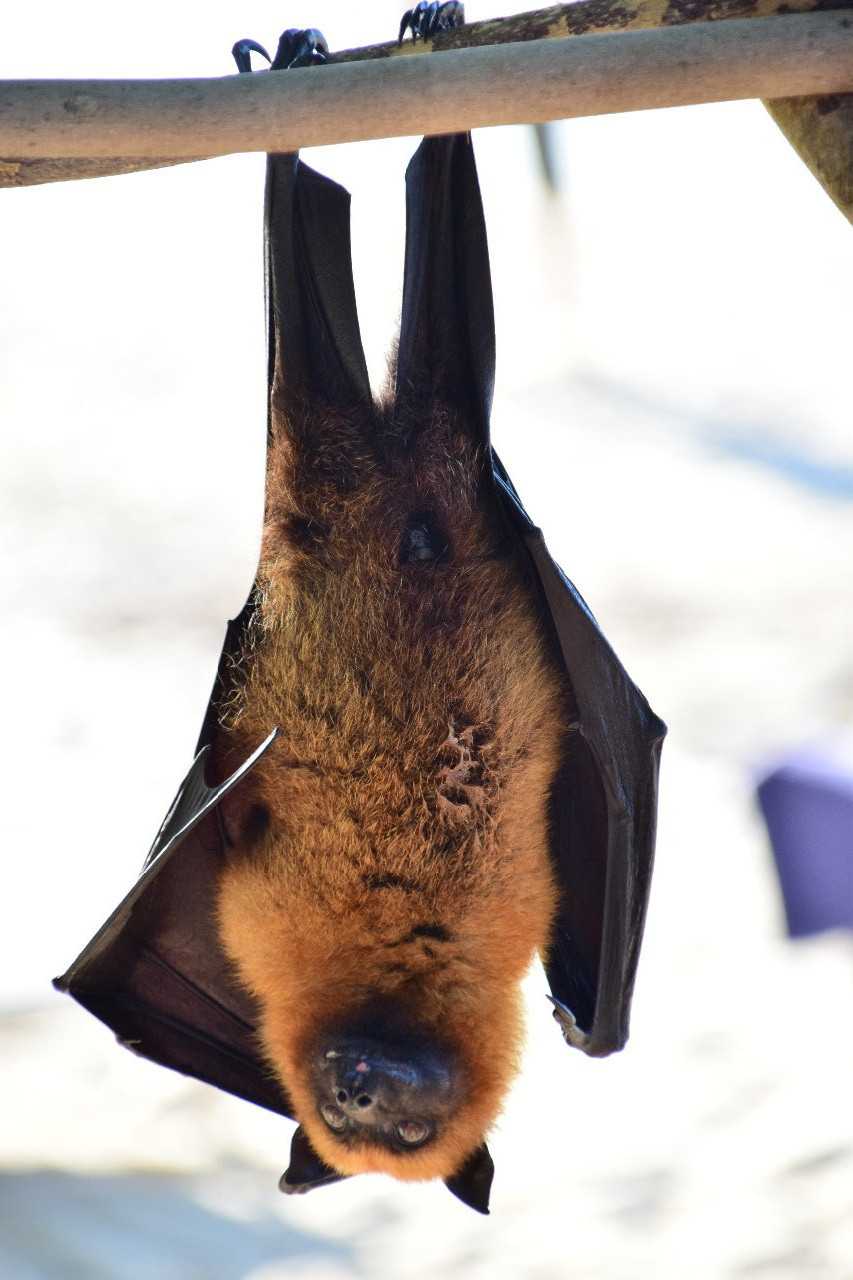
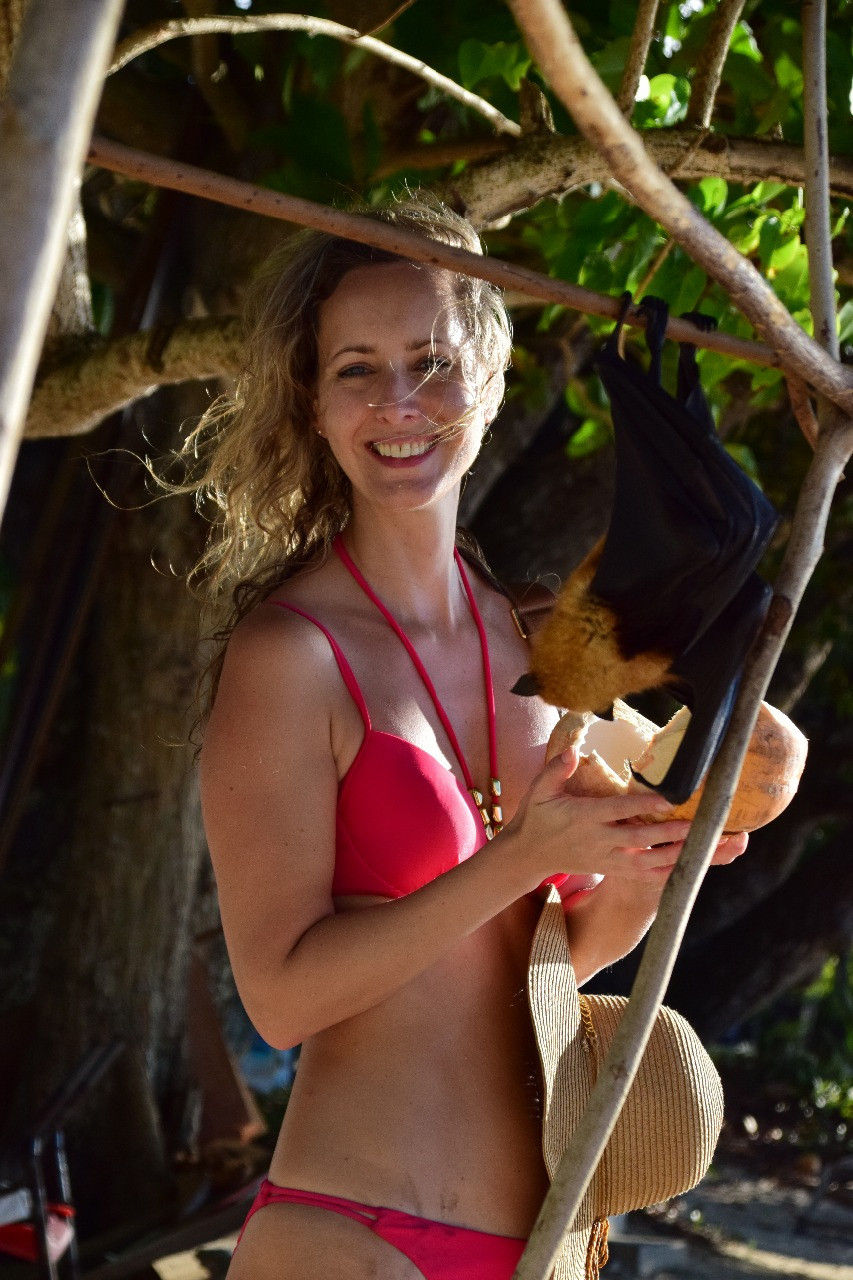
The most interesting creature on the islands is without a doubt the giant fruit bat (flying fox). Their wingspan can reach 1 m. You definitely can’t miss them – they fly around the islands in numbers similar to swallows back home in summer. Stewed fruit bat is also a local delicacy. They’re called flying foxes – they look like bats but, unlike bats, they don’t use echolocation, only their eyes. They fly during the day and don’t eat meat, only fruit.
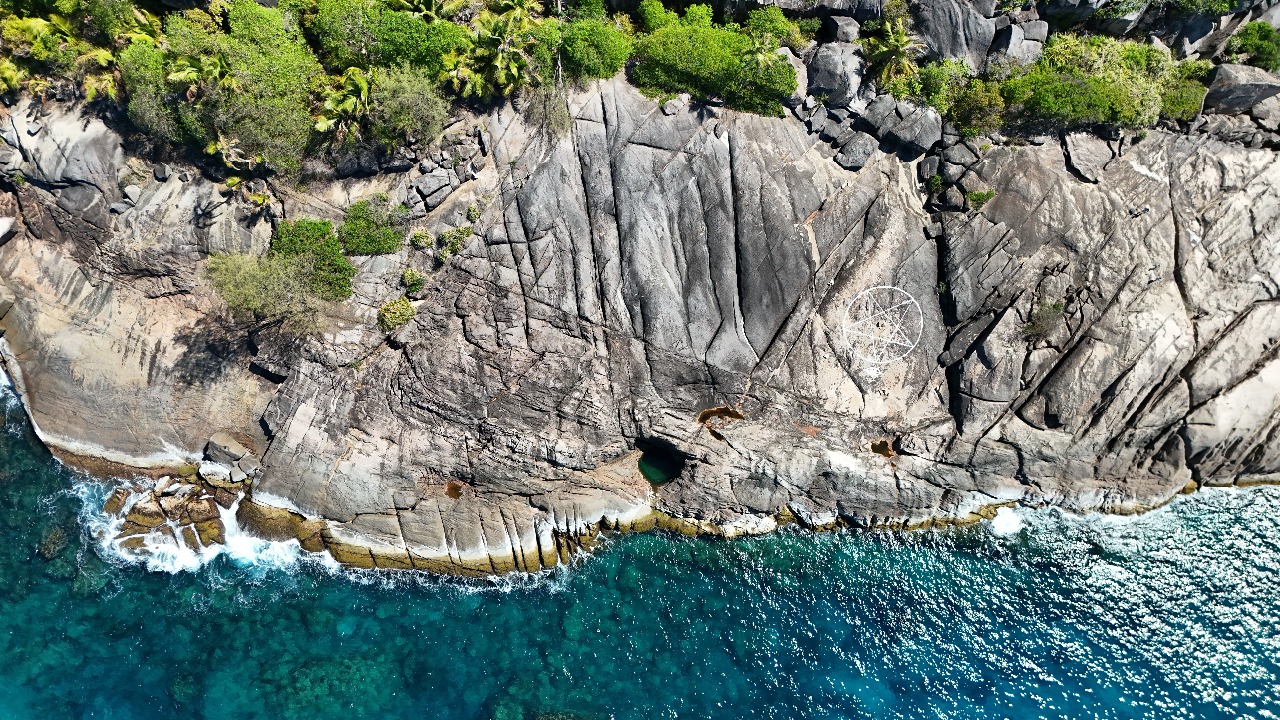
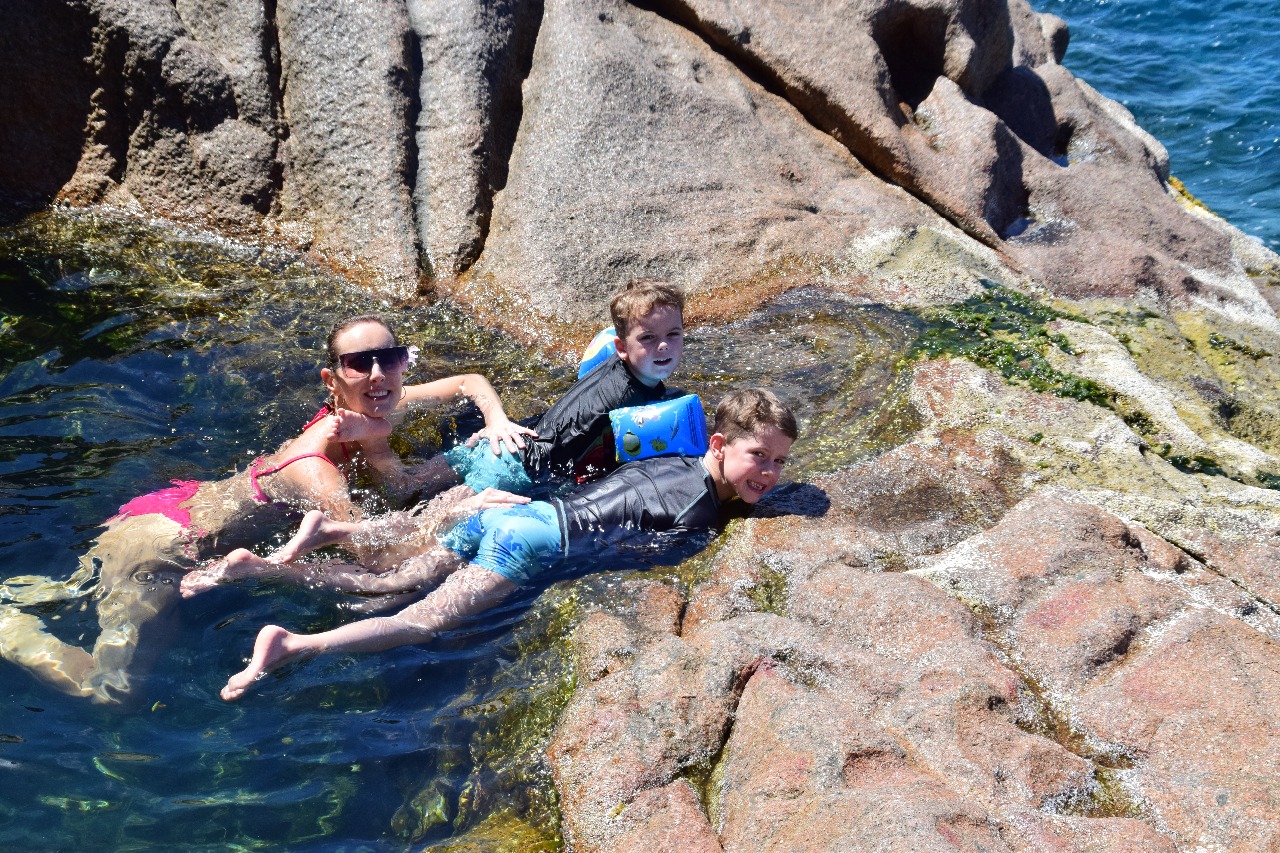
Another beautiful spot on Mahé is the Rock Pool – a natural rock pool about 6 m in diameter, which is filled by water during heavy surf at high tide and at low tide sits about 3–4 m above sea level. The hike there takes about an hour with kids. Finding it is a bit tricky; in the end we used a drone. But swimming in it was absolutely worth it.
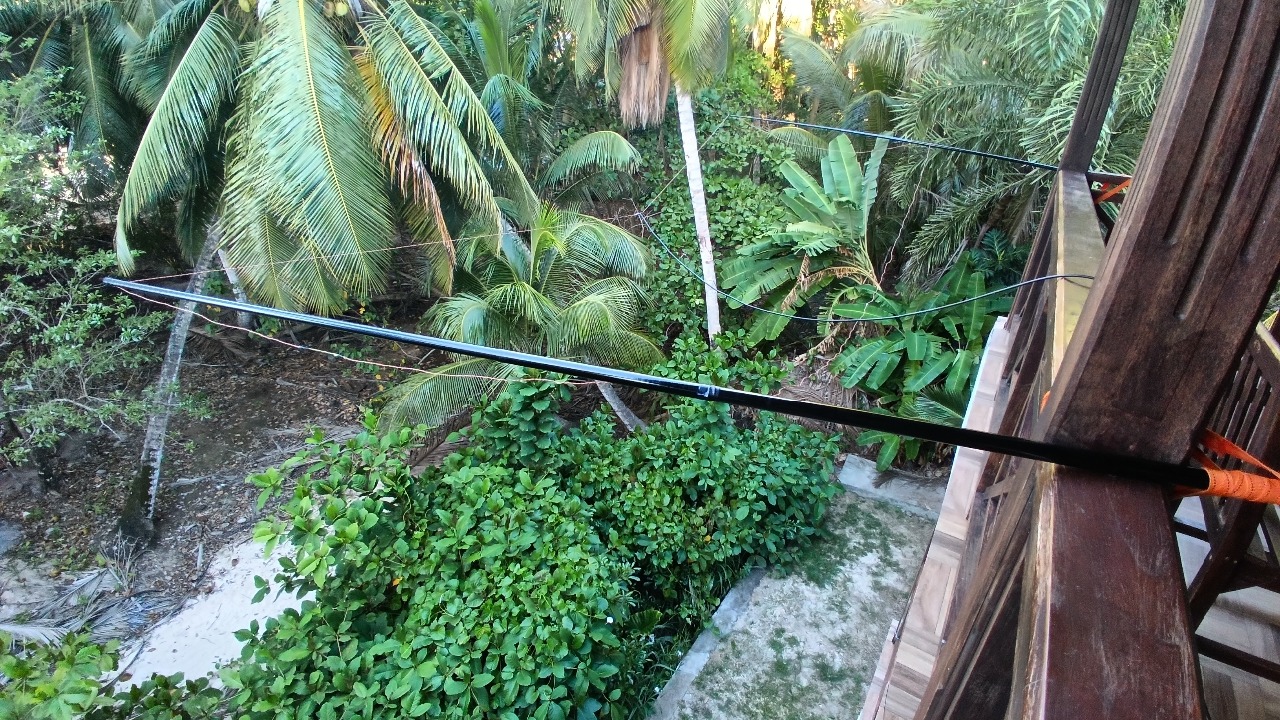
During the first week I showed up on 21 or 28 MHz every morning and evening (time difference to the Czech Republic is +3 hours). I also made a few QSOs in the LZ DX Contest. I experienced some nice pileups on 28 MHz SSB, where I had to listen by numbers, because 50–80 stations calling at once are hard to copy even in split. As an antenna I used one MOXON loop – I stuck two fibreglass poles horizontally out from the terrace and strapped them to the railing, and mounted the MOXON between them, fixed roughly towards Europe. When the band opened, it worked amazingly well, even in the middle of a palm grove with the antenna only about 7 m above ground.
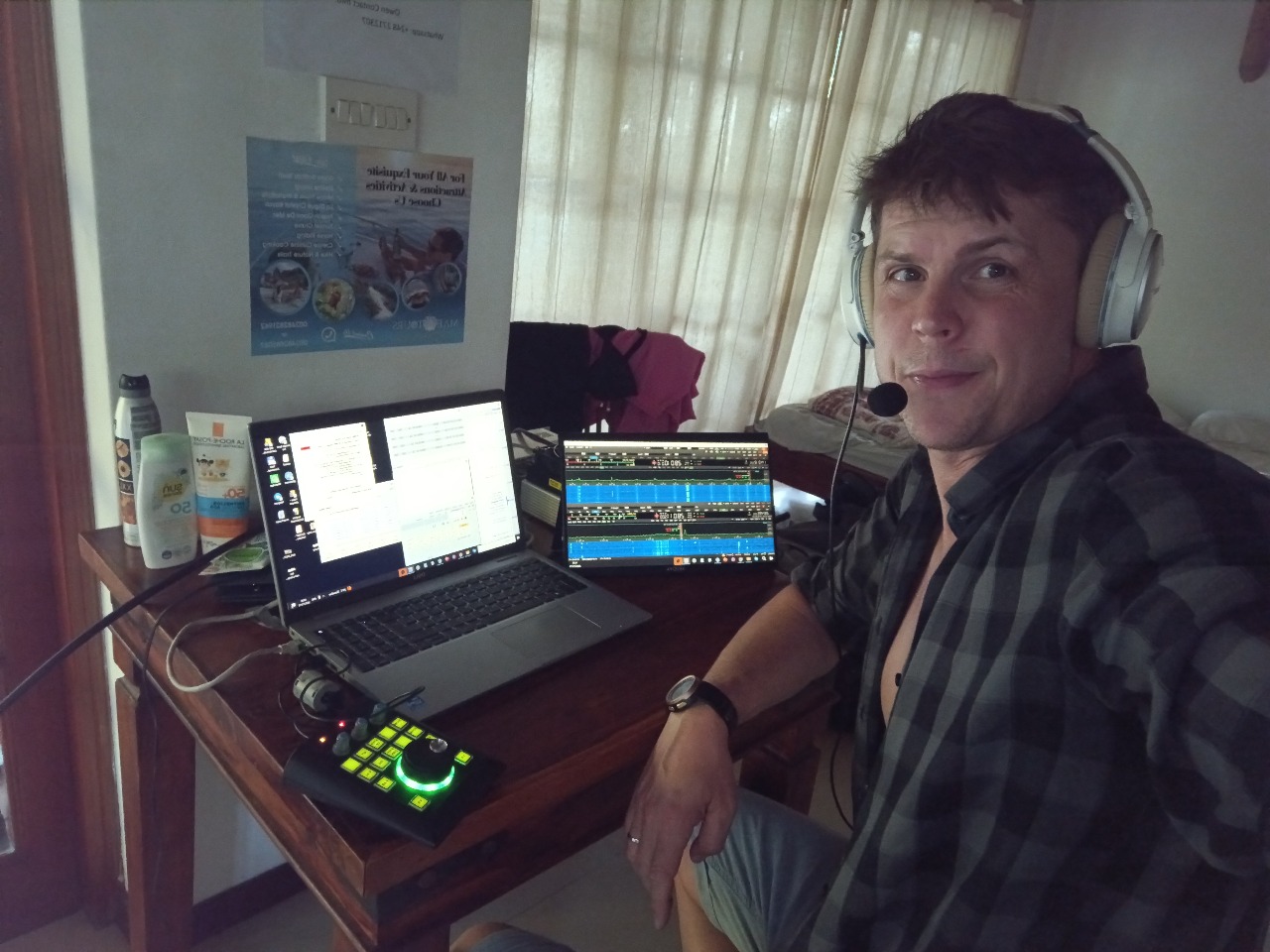
I could have had pileups practically all the time, but that’s not what we were there for :-). You can’t exactly ignore wild fun with the kids on the beach or early morning attempts to catch fish from the shore. Snorkelling and swimming would deserve a chapter of their own. The underwater life is incredibly rich – you can watch it for hours until your calves are completely sunburnt. The sea turtles are definitely worth mentioning; with a bit of luck you’ll encounter them at least once and can watch them in their natural environment.
After an intense week, when I was sleeping maybe 4–5 hours a day, we planned another trip for Monday and went to bed. On Monday morning I woke up and just to be sure I checked our ferry time to the second island for Tuesday. To my horror I realised I’d been living in the illusion that we still had one more full day, but we didn’t. So within an hour we had to quickly pack everyone and everything and head for the harbour on the other side of the island. We returned the car, dragged all six suitcases and four backpacks to the ferry check-in in the heat. After a small surcharge for two extra pieces of luggage we sat down on a comfortable air-conditioned passenger-only catamaran about the size of six buses. After 1 hour 15 minutes we found ourselves in the calmer environment of Praslin island, where two guys from the car rental company were already waiting and helped us with the luggage into another Suzuki. I folded down one rear seat, inflated the booster seats, squeezed the boys in together and stuffed all the bags into the boot and onto the rear seat. We got the usual local warning not to park the car under coconut palms. Fun coconut fact – it’s apparently about 15 times more likely that a falling coconut will kill you than a shark. The moral of the story? Don’t lie under palm trees, swim in the sea 15× less often and you might live to die of natural causes.
On Praslin there are basically only two main roads. One almost around (really only almost) the island, and a second one that slightly shortens the route from the harbour to the airport by cutting through the jungle hills. The ring road is about 30 km long. The entire island is about 13 km long and 5 km wide. But the roads here are relatively wider and safer, and the traffic is minimal.
I spent a long time searching for accommodation on Praslin on Booking. It’s not easy to find a place where you can put up two small masts and still have both main directions to EU/USA–JA open. In the end I chose a truly iconic house on the northwest of the island, not by the sea but on a hillside at about 150 m ASL – for a radio amateur, a unique spot. I had read in reviews that the house was great but had a really steep driveway. I’ve read that on other trips as well, and I didn’t pay much attention. My wife also had an international licence, so the plan was that while I was contesting she would drive the kids to the beach about 2 km away. Yeah… that didn’t work. I had never driven up such a steep hill before. Even the 4×4 slammed and spun a bit and just barely crawled up to the house. At that moment I said we’d better arrange some transport for my wife and kids to the beach rather than risk them rolling down a steep hill in a rental car. The owner immediately offered that it was no problem – he or his father would drive them whenever needed.
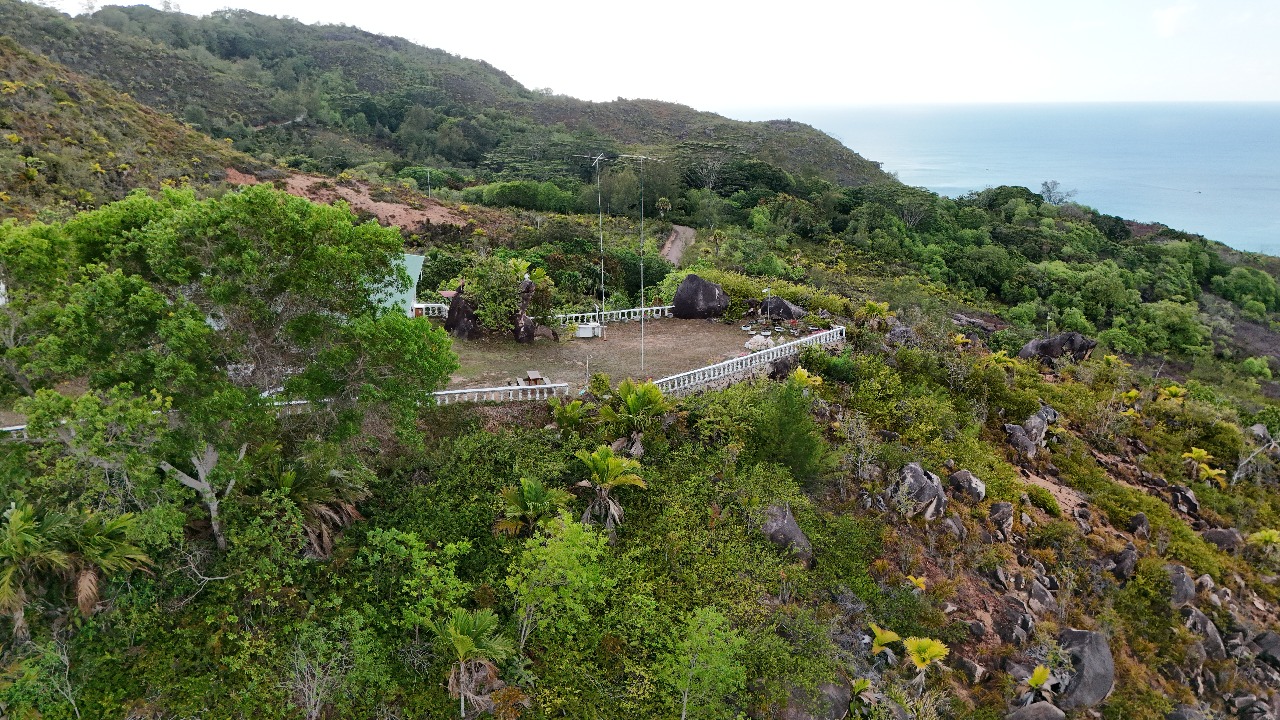
When we got chatting while paying, he mentioned that some years ago a group of Japanese hams had operated from there. A couple of days later, purely by coincidence, a Japanese radio amateur contacted me via Facebook and sent me a link to a website with pictures showing how they had built a Spiderbeam and verticals exactly where I was. Small world and no shortage of coincidences.
We unpacked, it was already pretty hot and the sun was blazing. So we headed straight to the sea. In the evening we did a basic shop in the local Indian-run mini-market. Indians are there something like the Vietnamese are in the Czech Republic. Except there are no supermarket chains, so small local grocery shops on every corner are the main place to buy anything. I remembered how notorious Czech guy Radovan Krejčíř almost wiped out the only local paper manufacturer during his “stay” in the Seychelles. Apparently he didn’t like the only toilet paper available; he said it was crap (pun intended). So he started importing toilet paper from Europe and almost killed the local factory. So I started looking for “Made in Czechia” toilet paper. In vain. I guess after he left, imports stopped and the paper factory recovered. And the result? I have to say that on both islands there was only one toilet paper from one manufacturer “Made in Seychelles” – and it was soft and nice, three-ply. So the competition in that area probably did its job to everyone's benefit. The only Czech products I saw in the shops were Hamé ham in a tub and, surprisingly, colourful “Arizona” rice snacks. The local Indian shopkeeper told me they are very popular with kids.
Back to radio. In the evening, after we came back from the beach and shopping, I started putting up the two masts and antennas. I still hadn’t decided which band I would do in the contest. At dusk I started assembling the first aluminium telescopic mast; with a headlamp it went quickly. Nothing was missing. Around 10 p.m. I had the first mast up with a MOXON for 15 m. Then I quickly put up a 40 m vertical and by 1 a.m. I had the second mast ready to be extended for another beam. I made a handful of quick QSOs on 40 m. The band was surprisingly good – lots of EU stations and here and there someone from NA or JA calling in. I went to sleep for about 3 hours. At 5 a.m., just before sunrise, I went out to raise the second mast to full height. Both masts were guyed at two levels. There was no space to tilt them up over a base pin, so from a certain height I had to keep loosening all four guys, pull the mast up a bit until they were tight again, then run around, loosen all four again, and so on. I did that about 10 times until the mast with MOXON reached the final height of about 12 m. On the first mast I also briefly tested a 2-over-2 MOXON stack. It turned out to have almost no benefit, because the lower antenna was only at 7 m. Compared to the second mast with a single antenna at 12 m closer to the edge of the slope, both systems seemed identical. So I changed the plan: I took the third antenna down and left two MOXONs at the same height side by side, 7 m apart, with the option to feed them in phase (0° shift) towards EU/USA. This in-phase horizontal stack narrowed the horizontal beamwidth but gave about 2–3 dB gain on the S-meter. Which, for 100 W and the ability to have two different directions with a portable setup, is pretty cool. The goal was to have two directions because JA and EU were supposed to be open at the same time for quite a while, and from there those directions are roughly 90° apart. When JA closed, I could swing both antennas to EU, and the main benefit was that the extra 1 S-unit helped especially into far-away USA.
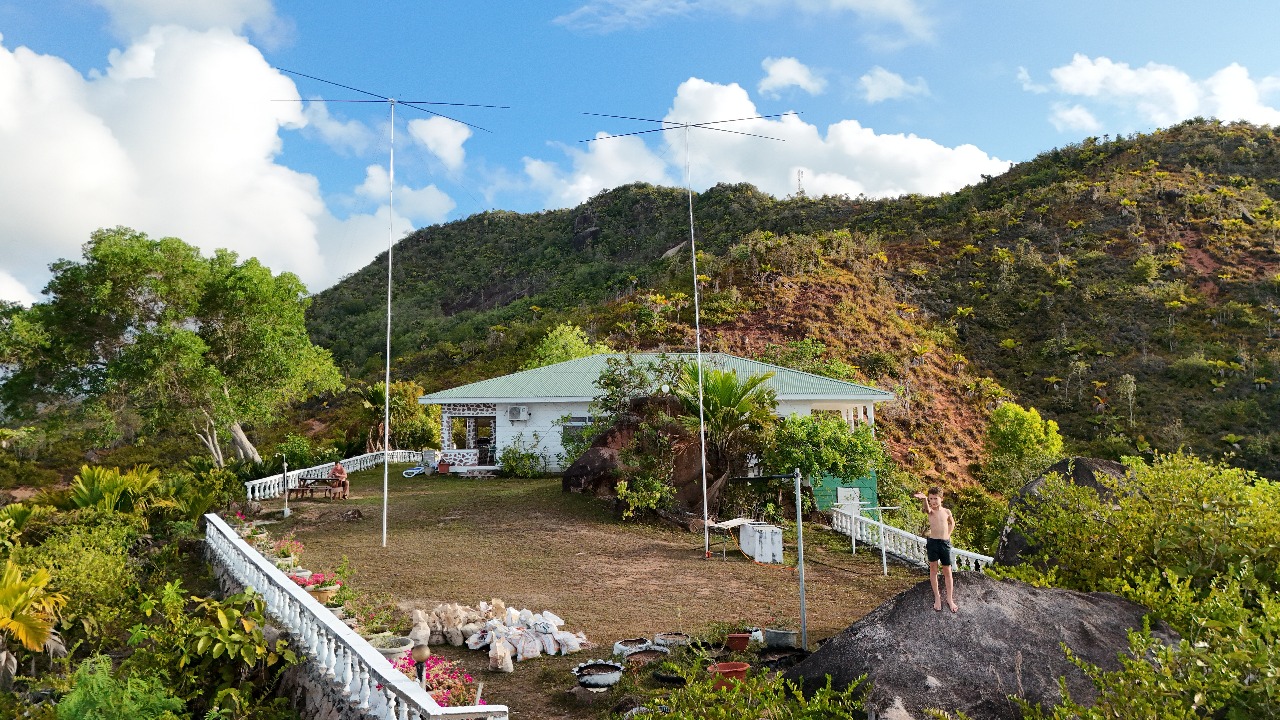
By 8 a.m. everything was ready. The overnight setup build worked out great. And on Wednesday morning we were free to head out for more adventures. My wife was, as usual, absolutely amazing. She got the kids ready and prepared everything for the trip, including food, drinks, coffee, breakfast, and even covered me head to toe in sun cream :-).
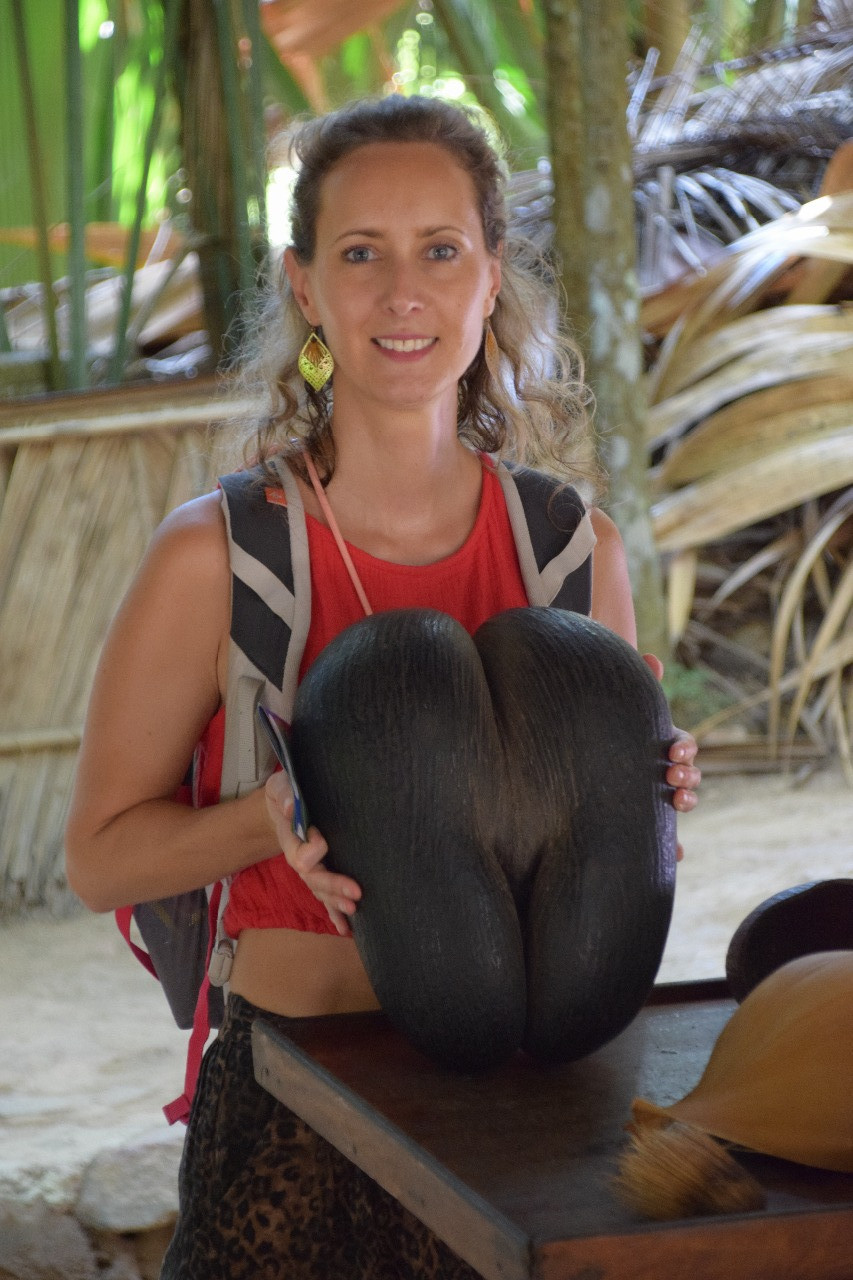
On Wednesday morning we went to Vallée de Mai – a world-famous nature reserve (UNESCO-listed). It’s the home of the endemic palm Lodoicea maldivica (Coco de Mer) with the largest seed in the world and the rare black parrot, offering a unique walk through a primeval forest full of endemic species and often referred to as the biblical “Paradise”. It’s one of the main natural jewels of the Seychelles, accessible via marked trails. The palm fruits have a really unique shape (see photos). The boys called it the “bum-palm”. That same day we visited several more beaches, swam, relaxed, flew the drone, and in the evening I operated.
The next day, Thursday, we did about a 1.5-hour hike to the gorgeous Anse Georgette beach, which can otherwise only be reached by boat in good conditions, or if you’re a guest at the massive local golf resort with its own heliport.
After this quite exhausting day out on Thursday, I enjoyed a very nice opening to Europe on 21 MHz SSB. A /mobile station was 59+10 here and I was getting similar reports back. So conditions looked very promising for the contest. However, only later did I realise that this was the start of a geomagnetic disturbance, more precisely its initial positive phase. Over the next days conditions just deteriorated, although the pileups remained large.
On Friday before the contest we took a full-day boat trip. In a group of about 12 tourists we went snorkelling, circled the island, enjoyed an excellent Creole lunch with grilled fish, met the local giant tortoises that live free on nearby Curieuse Island (about 200 animals, with the oldest around 120 years old), walked with a guide through a mangrove forest and strolled a beach where about one-metre baby lemon sharks swam in the shallows. I would highly recommend this. A day spent like that was absolutely unique – the local guides are real pros, they don’t rip you off, they’re friendly, speak excellent English and know a huge amount about the protected local flora and fauna.
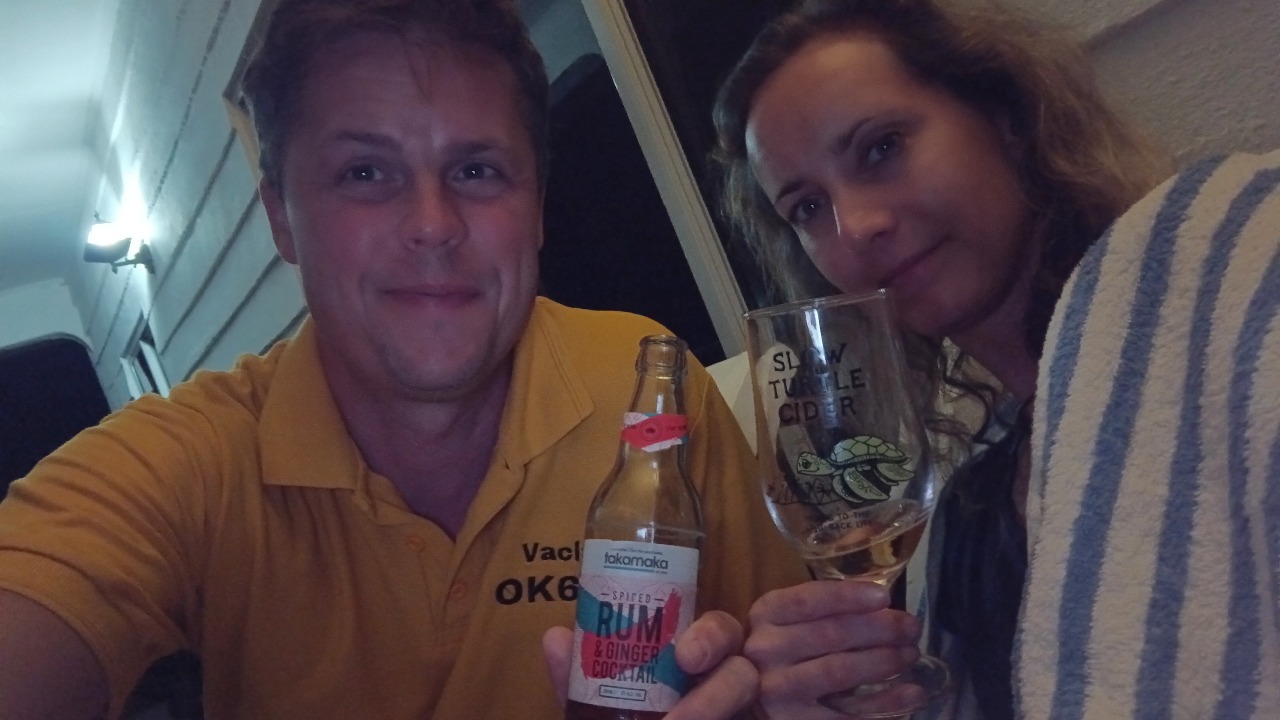
On Friday evening before the contest my wife and I still had time for a local cocktail we bought from the Indian shop. I had everything set up and ready. I could go to bed, as 0 UTC is 4 a.m. in the Seychelles.
The contest itself on 15 m did not get off to a great start. I slowly started hearing stations like YB, BY, VU, now and then JA, DS, KH6, VR. But a typical local phenomenon showed up: signals were quite good on receive, but the return path was bad. So a station that was 559 here simply couldn’t be logged because they didn’t hear me at all for an hour. Then suddenly, after about two hours of this effect, it was like someone flicked a switch – within 10 minutes everything was fine and I could work everything I heard, and finally stations started to call me on CQ. However, JA remained poor. And that stayed the case until the end of the contest :-). The opening to Europe on Saturday was reasonably good and long, about 7 hours. Around dusk the first US stations appeared and at the same time the Europeans started to fade. And now the exact opposite effect from the morning showed up. I called CQ, lots of stations replied, but I heard them at the noise floor or not at all. That lasted about 1.5 hours. Then, again, “click” and suddenly I heard them perfectly. Unfortunately the US pileup didn’t last long. The band pretty much shut down around midnight. There was nothing to do but go to bed. After the first day with about 1,200 QSOs it was clear that I wouldn’t beat the record from Guadeloupe. There I had 2,200 QSOs logged after the first day. Still, it was a lot of fun. The second day was a bit slower, though conditions to JA and USA were better. But the sheer distance to the USA, less than stellar conditions, and the band closing towards JA were limiting.
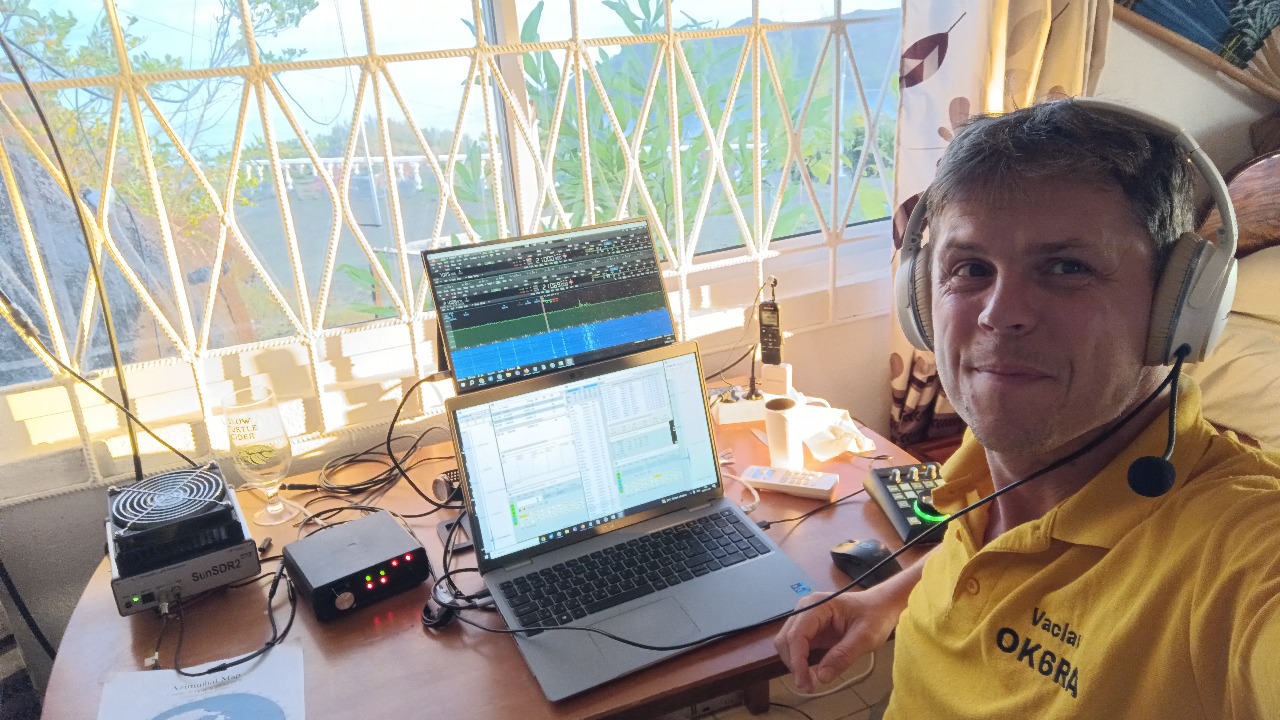
I switched everything off sometime around midnight local time on Sunday, about 4 hours before the end of the contest, when it was clear nothing special would happen. I submitted the log, and after midnight, with my headlamp on, I completely dismantled one mast with its antenna, and lowered the other one so I wouldn’t have to do it under the blazing sun. I got a little sleep and on Monday morning, before it got too hot, I took everything down; by 10 a.m. it was all packed and ready for the Tuesday journey home.
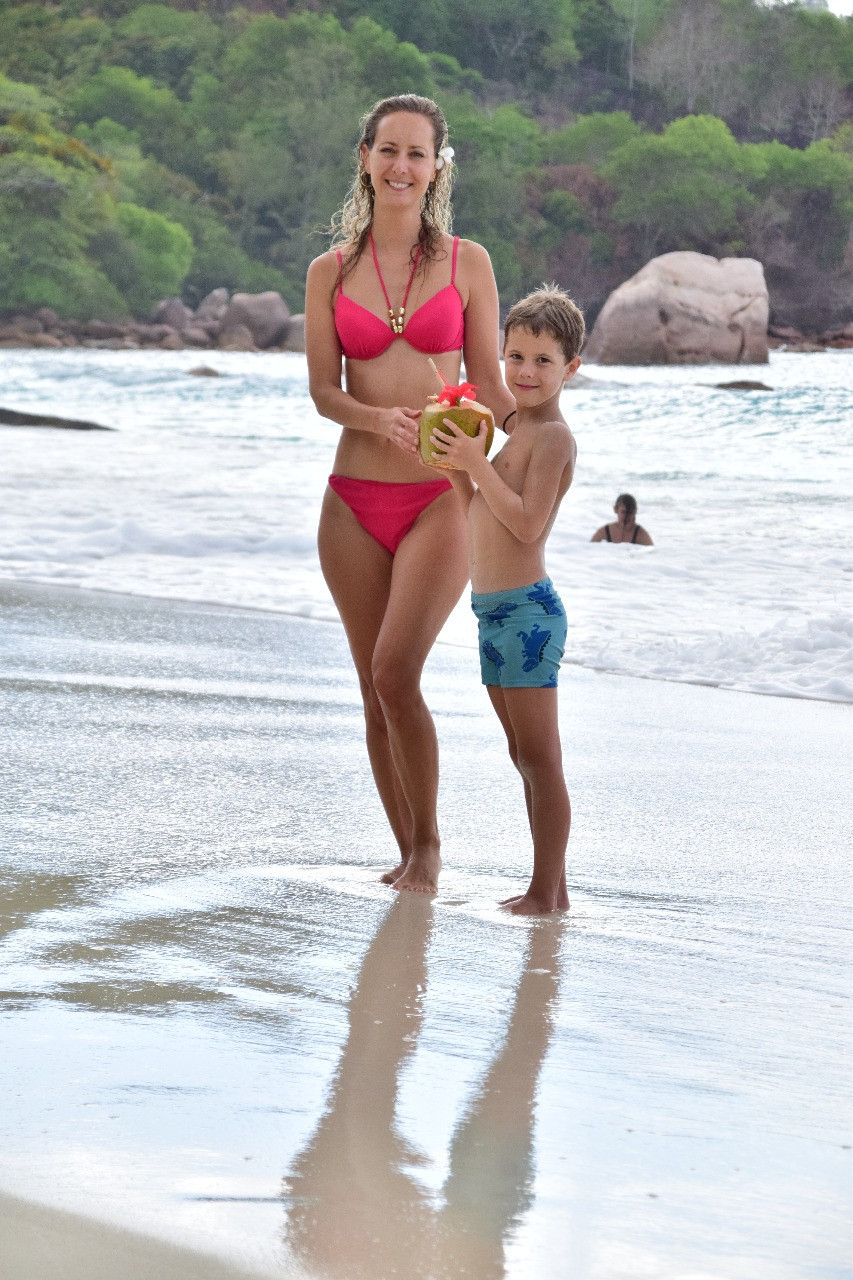
On Monday we spent a lovely last day at the famous nearby Anse Lazio beach, and Tuesday was all about returning the rental car at the harbour. That’s where a small “vomit incident” happened: Šimon got sick about a minute before we stopped by the car-rental representative. The guy first rushed to welcome us, but when I pointed out the puked-on kid, he seemed a bit less enthusiastic. Still, he didn’t make a fuss about the soiled seat. He saw we had enough on our plate in the heat. He took the car back without any extra cleaning charges.
We took the ferry back to Mahé, then a pre-arranged minivan to the airport, about 20 minutes away along their “motorway” where you can even go 80 km/h.
We had a pretty generous time cushion. We got to the airport at 10 a.m. and the flight to Qatar was at 18:15. We spent the time resting, watching cartoons, and I went through and deleted about 4 hours of footage from the air, the ground and underwater.
The trip home, with a transfer in Doha again, went smoothly. The boys slept and my wife and I did too. At 6:15 a.m. we arrived at Prague Airport. The cold weather surprised us again, but at least the snow had melted.
Thanks to everyone who worked me. I always tried to give priority in the pileups to OK and OM stations. I hope I managed that, even though I didn’t do that many QSOs this time :-)
As the saying goes, an experience doesn’t have to be positive, it just has to be intense. In our case, after this holiday, the experience was definitely positive – and definitely intense.
RAW score from contest seems nice. 1st place WORD.
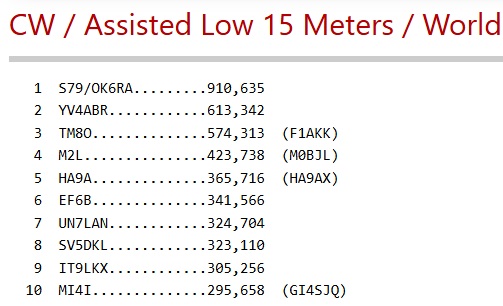
Statistics:
Outside contests:
Band   Mode  QSOs
   7   CW      44
   7   LSB      2
  14   CW     371
  21   CW     285
  21   USB    273
  28   CW     385
  28   USB    476
Total  Both  1836
In LZ DX Contest:
Band   Mode  QSOs
  28   CW     146
  28   USB      5
Total  Both   151
In CQ WW CW in SO(A)15LP:
Band    QSOs    Pts   ZN  Cty  Pt/Q
   7      15     43    6   10   2.9
  21    1853   5521   35  129   3.0
Total  1868   5564   41  139   3.0

Score: 1 001 520
1 Mult = 10.4 Q's
So in total just under 4,000 QSOs.